Brent G. T. Else, Araleigh Cranch, Richard P. Sims, Samantha Jones, Laura A. Dalman, Christopher J. Mundy, Rebecca A. Segal, Randall K. Scharien, and Tania Guha
The Cryosphere, 16, 3685–3701, https://doi.org/10.5194/tc-16-3685-2022,https://doi.org/10.5194/tc-16-3685-2022, 2022
Short summary
Short summary
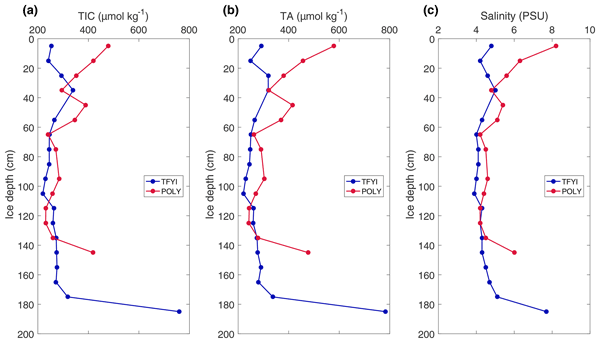
Sea ice helps control how much carbon dioxide polar oceans absorb. We compared ice cores from two sites to look for differences in carbon chemistry: one site had thin ice due to strong ocean currents and thick snow; the other site had thick ice, thin snow, and weak currents. We did find some differences in small layers near the top and the bottom of the cores, but for most of the ice volume the chemistry was the same. This result will help build better models of the carbon sink in polar oceans.
Brent G. T. Else, Araleigh Cranch, Richard P. Sims, Samantha Jones, Laura A. Dalman, Christopher J. Mundy, Rebecca A. Segal, Randall K. Scharien, and Tania Guha
The Cryosphere, 16, 3685–3701, https://doi.org/10.5194/tc-16-3685-2022,https://doi.org/10.5194/tc-16-3685-2022, 2022
Short summary
Short summary
Sea ice helps control how much carbon dioxide polar oceans absorb. We compared ice cores from two sites to look for differences in carbon chemistry: one site had thin ice due to strong ocean currents and thick snow; the other site had thick ice, thin snow, and weak currents. We did find some differences in small layers near the top and the bottom of the cores, but for most of the ice volume the chemistry was the same. This result will help build better models of the carbon sink in polar oceans.