
11 Aug 2026
| 11 Aug 2026
Mapping Exotic Plant Invasions in the Caribbean
Maarten B. Eppinga
Department of Geography, University of Zurich, Zurich, Switzerland
Maria J. Santos
Department of Geography, University of Zurich, Zurich, Switzerland
Margarita E. López-Álzate
Sustainable Island Solutions through Science, Technology, Engineering and Mathematics (SISSTEM), University of Aruba, Oranjestad, Aruba
Related authors
Britta Ricker, Maarten Eppinga, Sharona Jurgens, and Eric Mijts
Abstr. Int. Cartogr. Assoc., 7, 137, https://doi.org/10.5194/ica-abs-7-137-2024, https://doi.org/10.5194/ica-abs-7-137-2024, 2024
Kaan Karaman, Yuchang Jiang, Damien Robert, Vivien Sainte Fare Garnot, Maria Joao Santos, and Jan Dirk Wegner
ISPRS Ann. Photogramm. Remote Sens. Spatial Inf. Sci., X-G-2025, 487–494, https://doi.org/10.5194/isprs-annals-X-G-2025-487-2025, https://doi.org/10.5194/isprs-annals-X-G-2025-487-2025, 2025
Kien Nguyen and Maria J. Santos
EGUsphere, https://doi.org/10.5194/egusphere-2024-2544, https://doi.org/10.5194/egusphere-2024-2544, 2024
Preprint archived
Short summary
Short summary
Plants affect the Amazon's water cycle through processes such as transpiration and evaporation. Characteristics related to leaf size and biomass have the most significant impact on atmospheric water content and land surface temperature, but they affect soil moisture content only minimally. These relationships also vary at extreme water cycle values and across Amazon subbasins. The study underscores the critical role of plants in maintaining the resilience of the Amazon’s hydrological processes.
Britta Ricker, Maarten Eppinga, Sharona Jurgens, and Eric Mijts
Abstr. Int. Cartogr. Assoc., 7, 137, https://doi.org/10.5194/ica-abs-7-137-2024, https://doi.org/10.5194/ica-abs-7-137-2024, 2024
Kien Nguyen and Maria J. Santos
EGUsphere, https://doi.org/10.5194/egusphere-2023-3069, https://doi.org/10.5194/egusphere-2023-3069, 2024
Preprint archived
Short summary
Short summary
Plants can impact the water cycle in the Amazon via transpiration and evaporation. Plants characteristics relating to leaf size and biomass have the strongest influence on atmospheric water content and land surface temperature, while having little effect on soil moisture content. The relationships also vary at extreme values of water process parameters and across Amazon subbasins. This study emphasizes the role of plants in maintaining the resilience of the Amazon's hydrological processes.
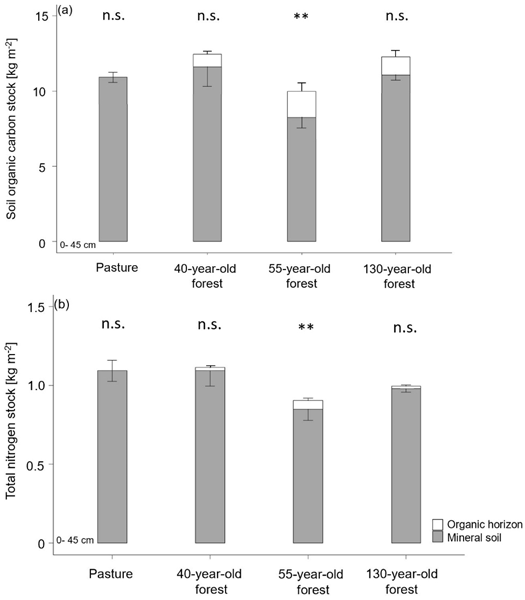
Tatjana C. Speckert, Jeannine Suremann, Konstantin Gavazov, Maria J. Santos, Frank Hagedorn, and Guido L. B. Wiesenberg
SOIL, 9, 609–621, https://doi.org/10.5194/soil-9-609-2023, https://doi.org/10.5194/soil-9-609-2023, 2023
Short summary
Short summary
Soil organic carbon (SOC) is key player in the global carbon cycle. Afforestation on pastures potentially alters organic matter input and SOC sequestration. We investigated the effects of a Picea abies L. afforestation sequence (0 to 130 years) on a former subalpine pasture on SOC stocks and dynamics. We found no difference in the SOC stock after 130 years of afforestation and thus no additional SOC sequestration. SOC composition was altered due to a modified SOC input following afforestation.


