The changing role of the map in Western European society over the last 250 years
Philippe De Maeyer
Ghent University, Belgium
Related authors
Hao Guo, Qinghou Hang, Xiangchen Meng, Ye Yuan, Ying Cao, Yunqian Wang, and Philippe De Maeyer
EGUsphere, https://doi.org/10.5194/egusphere-2026-3287, https://doi.org/10.5194/egusphere-2026-3287, 2026
This preprint is open for discussion and under review for Natural Hazards and Earth System Sciences (NHESS).
Short summary
Short summary
We tracked heatwaves over mainland China as continuous events moving through space and time. Since 2012, heatwaves have become less a matter of more events and more a matter of stronger event processes: longer duration, larger affected area, greater cumulative heat, and longer travel distance. These results suggest that heatwave monitoring should track event persistence and mobility, not only local frequency or intensity.
Philippe de Maeyer and Jan Vandersmissen
Abstr. Int. Cartogr. Assoc., 10, 55, https://doi.org/10.5194/ica-abs-10-55-2025, https://doi.org/10.5194/ica-abs-10-55-2025, 2025
Haiyang Shi, Geping Luo, Olaf Hellwich, Xiufeng He, Alishir Kurban, Philippe De Maeyer, and Tim Van de Voorde
Hydrol. Earth Syst. Sci., 27, 4551–4562, https://doi.org/10.5194/hess-27-4551-2023, https://doi.org/10.5194/hess-27-4551-2023, 2023
Short summary
Short summary
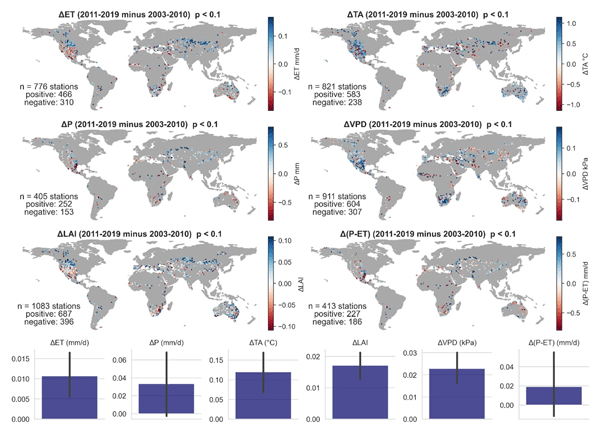
Using evidence from meteorological stations, this study assessed the climatic, hydrological, and ecological aridity changes in global drylands and their associated mechanisms. A decoupling between atmospheric, hydrological, and vegetation aridity was found. This highlights the added value of using station-scale data to assess dryland change as a complement to results based on coarse-resolution reanalysis data and land surface models.
Haiyang Shi, Geping Luo, Olaf Hellwich, Alishir Kurban, Philippe De Maeyer, and Tim Van de Voorde
Biogeosciences, 20, 2727–2741, https://doi.org/10.5194/bg-20-2727-2023, https://doi.org/10.5194/bg-20-2727-2023, 2023
Short summary
Short summary
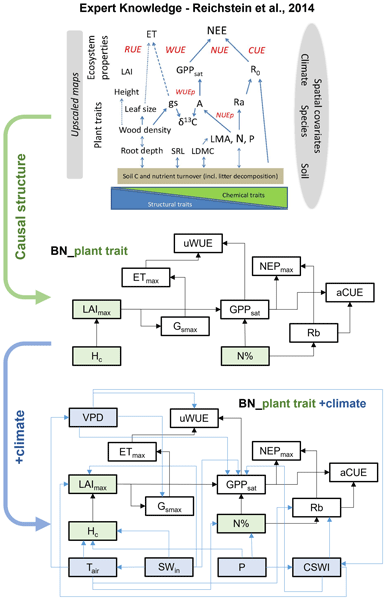
In studies on the relationship between ecosystem functions and climate and plant traits, previously used data-driven methods such as multiple regression and random forest may be inadequate for representing causality due to limitations such as covariance between variables. Based on FLUXNET site data, we used a causal graphical model to revisit the control of climate and vegetation traits over ecosystem functions.
Haiyang Shi, Geping Luo, Olaf Hellwich, Mingjuan Xie, Chen Zhang, Yu Zhang, Yuangang Wang, Xiuliang Yuan, Xiaofei Ma, Wenqiang Zhang, Alishir Kurban, Philippe De Maeyer, and Tim Van de Voorde
Hydrol. Earth Syst. Sci., 26, 4603–4618, https://doi.org/10.5194/hess-26-4603-2022, https://doi.org/10.5194/hess-26-4603-2022, 2022
Short summary
Short summary
There have been many machine learning simulation studies based on eddy-covariance observations for water flux and evapotranspiration. We performed a meta-analysis of such studies to clarify the impact of different algorithms and predictors, etc., on the reported prediction accuracy. It can, to some extent, guide future global water flux modeling studies and help us better understand the terrestrial ecosystem water cycle.
Philippe De Maeyer
Abstr. Int. Cartogr. Assoc., 5, 3, https://doi.org/10.5194/ica-abs-5-3-2022, https://doi.org/10.5194/ica-abs-5-3-2022, 2022
Haiyang Shi, Geping Luo, Olaf Hellwich, Mingjuan Xie, Chen Zhang, Yu Zhang, Yuangang Wang, Xiuliang Yuan, Xiaofei Ma, Wenqiang Zhang, Alishir Kurban, Philippe De Maeyer, and Tim Van de Voorde
Biogeosciences, 19, 3739–3756, https://doi.org/10.5194/bg-19-3739-2022, https://doi.org/10.5194/bg-19-3739-2022, 2022
Short summary
Short summary
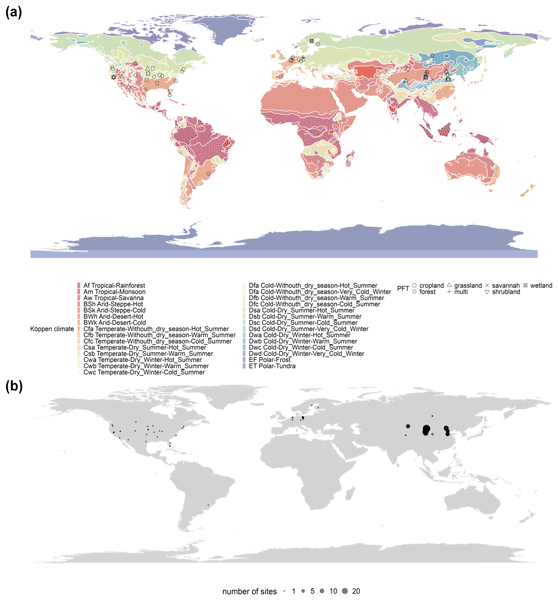
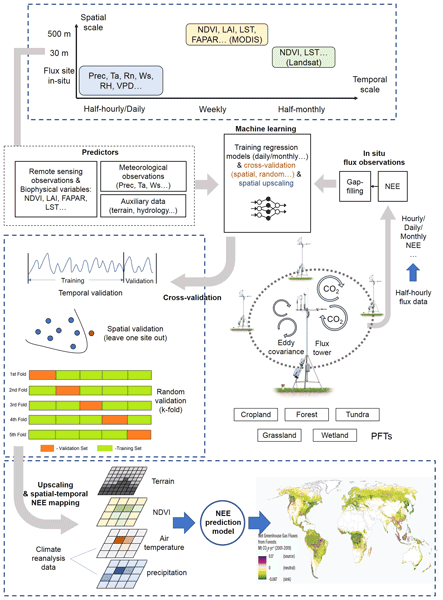
A number of studies have been conducted by using machine learning approaches to simulate carbon fluxes. We performed a meta-analysis of these net ecosystem exchange (NEE) simulations. Random forests and support vector machines performed better than other algorithms. Models with larger timescales had a lower accuracy. For different plant functional types (PFTs), there were significant differences in the predictors used and their effects on model accuracy.
Jana Ameye, Philippe De Maeyer, Mario Hernandez, and Luc Zwartjes
Abstr. Int. Cartogr. Assoc., 3, 5, https://doi.org/10.5194/ica-abs-3-5-2021, https://doi.org/10.5194/ica-abs-3-5-2021, 2021
Hao Guo, Qinghou Hang, Xiangchen Meng, Ye Yuan, Ying Cao, Yunqian Wang, and Philippe De Maeyer
EGUsphere, https://doi.org/10.5194/egusphere-2026-3287, https://doi.org/10.5194/egusphere-2026-3287, 2026
This preprint is open for discussion and under review for Natural Hazards and Earth System Sciences (NHESS).
Short summary
Short summary
We tracked heatwaves over mainland China as continuous events moving through space and time. Since 2012, heatwaves have become less a matter of more events and more a matter of stronger event processes: longer duration, larger affected area, greater cumulative heat, and longer travel distance. These results suggest that heatwave monitoring should track event persistence and mobility, not only local frequency or intensity.
Philippe de Maeyer and Jan Vandersmissen
Abstr. Int. Cartogr. Assoc., 10, 55, https://doi.org/10.5194/ica-abs-10-55-2025, https://doi.org/10.5194/ica-abs-10-55-2025, 2025
Haiyang Shi, Geping Luo, Olaf Hellwich, Xiufeng He, Alishir Kurban, Philippe De Maeyer, and Tim Van de Voorde
Hydrol. Earth Syst. Sci., 27, 4551–4562, https://doi.org/10.5194/hess-27-4551-2023, https://doi.org/10.5194/hess-27-4551-2023, 2023
Short summary
Short summary
Using evidence from meteorological stations, this study assessed the climatic, hydrological, and ecological aridity changes in global drylands and their associated mechanisms. A decoupling between atmospheric, hydrological, and vegetation aridity was found. This highlights the added value of using station-scale data to assess dryland change as a complement to results based on coarse-resolution reanalysis data and land surface models.
Haiyang Shi, Geping Luo, Olaf Hellwich, Alishir Kurban, Philippe De Maeyer, and Tim Van de Voorde
Biogeosciences, 20, 2727–2741, https://doi.org/10.5194/bg-20-2727-2023, https://doi.org/10.5194/bg-20-2727-2023, 2023
Short summary
Short summary
In studies on the relationship between ecosystem functions and climate and plant traits, previously used data-driven methods such as multiple regression and random forest may be inadequate for representing causality due to limitations such as covariance between variables. Based on FLUXNET site data, we used a causal graphical model to revisit the control of climate and vegetation traits over ecosystem functions.
Haiyang Shi, Geping Luo, Olaf Hellwich, Mingjuan Xie, Chen Zhang, Yu Zhang, Yuangang Wang, Xiuliang Yuan, Xiaofei Ma, Wenqiang Zhang, Alishir Kurban, Philippe De Maeyer, and Tim Van de Voorde
Hydrol. Earth Syst. Sci., 26, 4603–4618, https://doi.org/10.5194/hess-26-4603-2022, https://doi.org/10.5194/hess-26-4603-2022, 2022
Short summary
Short summary
There have been many machine learning simulation studies based on eddy-covariance observations for water flux and evapotranspiration. We performed a meta-analysis of such studies to clarify the impact of different algorithms and predictors, etc., on the reported prediction accuracy. It can, to some extent, guide future global water flux modeling studies and help us better understand the terrestrial ecosystem water cycle.
Philippe De Maeyer
Abstr. Int. Cartogr. Assoc., 5, 3, https://doi.org/10.5194/ica-abs-5-3-2022, https://doi.org/10.5194/ica-abs-5-3-2022, 2022
Haiyang Shi, Geping Luo, Olaf Hellwich, Mingjuan Xie, Chen Zhang, Yu Zhang, Yuangang Wang, Xiuliang Yuan, Xiaofei Ma, Wenqiang Zhang, Alishir Kurban, Philippe De Maeyer, and Tim Van de Voorde
Biogeosciences, 19, 3739–3756, https://doi.org/10.5194/bg-19-3739-2022, https://doi.org/10.5194/bg-19-3739-2022, 2022
Short summary
Short summary
A number of studies have been conducted by using machine learning approaches to simulate carbon fluxes. We performed a meta-analysis of these net ecosystem exchange (NEE) simulations. Random forests and support vector machines performed better than other algorithms. Models with larger timescales had a lower accuracy. For different plant functional types (PFTs), there were significant differences in the predictors used and their effects on model accuracy.
Jana Ameye, Philippe De Maeyer, Mario Hernandez, and Luc Zwartjes
Abstr. Int. Cartogr. Assoc., 3, 5, https://doi.org/10.5194/ica-abs-3-5-2021, https://doi.org/10.5194/ica-abs-3-5-2021, 2021