
14 Mar 2025
| 14 Mar 2025
Preface
Christophe Lienert
Secretariat Steering Committee Intervention in Natural Hazards LAINAT, c/o Swiss Federal Office for the Environment FOEN, Switzerland
Andreas Paul Zischg
Mobiliar Lab for Natural Risks, Oeschger Centre for Climate Change Research, Institute of Geography, University of Bern, Bern, Switzerland
Horst Kremers
RIMMA CoE, Berlin, Germany
Jamie McCaughey
Department of Environmental Systems Science, ETH Zurich, Zurich, Switzerland
Lara Zinkl
Mobiliar Lab for Natural Risks, Oeschger Centre for Climate Change Research, Institute of Geography, University of Bern, Bern, Switzerland
David N. Bresch
Department of Environmental Systems Science, ETH Zurich, Zurich, Switzerland
Related authors
Christophe Lienert, Franziska Angly Bieri, Stefan Beyeler, and Karsten Pippig
Abstr. Int. Cartogr. Assoc., 10, 174, https://doi.org/10.5194/ica-abs-10-174-2025, https://doi.org/10.5194/ica-abs-10-174-2025, 2025
Christophe Lienert, Franziska Angly Bieri, Wolfgang Ruf, Mathias Gross, and Mathias Zesiger
Abstr. Int. Cartogr. Assoc., 6, 140, https://doi.org/10.5194/ica-abs-6-140-2023, https://doi.org/10.5194/ica-abs-6-140-2023, 2023
Christophe Lienert, Franziska Angly Bieri, Irina Dallo, and Michèle Marti
Abstr. Int. Cartogr. Assoc., 5, 154, https://doi.org/10.5194/ica-abs-5-154-2022, https://doi.org/10.5194/ica-abs-5-154-2022, 2022
Christophe Lienert, Franziska Angly, Barbora Neveršil, and Daniel Meier
Abstr. Int. Cartogr. Assoc., 3, 180, https://doi.org/10.5194/ica-abs-3-180-2021, https://doi.org/10.5194/ica-abs-3-180-2021, 2021
Luca Gaetan Severino, Evelyn Mühlhofer, Nishadh Kalladath, and David Niklaus Bresch
EGUsphere, https://doi.org/10.5194/egusphere-2026-5363, https://doi.org/10.5194/egusphere-2026-5363, 2026
This preprint is open for discussion and under review for Natural Hazards and Earth System Sciences (NHESS).
Short summary
Short summary
Impact forecasts can help reduce negative consequences from weather and climate extremes. We present a framework that predicts flood-induced disruptions to healthcare accessibility for population and apply it to two recent flood events in Africa. Our model is able to provide actionable and timely information such as forecast maps of service accessibility. Our results illustrate how a model built on open-source data can provide decision-relevant impact forecasts to inform anticipatory action.
Christophe Lienert, Franziska Angly Bieri, Stefan Beyeler, and Karsten Pippig
Abstr. Int. Cartogr. Assoc., 10, 174, https://doi.org/10.5194/ica-abs-10-174-2025, https://doi.org/10.5194/ica-abs-10-174-2025, 2025
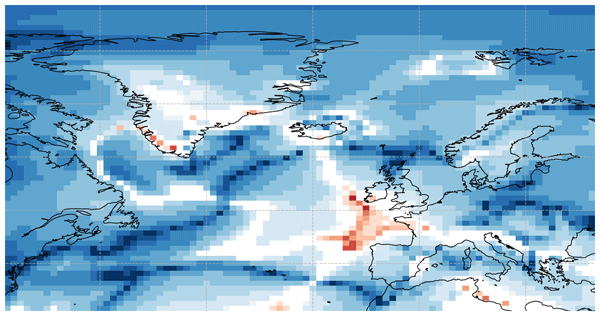
Luise J. Fischer, David N. Bresch, Dominik Büeler, Christian M. Grams, Robin Noyelle, Matthias Röthlisberger, and Heini Wernli
Weather Clim. Dynam., 6, 1027–1043, https://doi.org/10.5194/wcd-6-1027-2025, https://doi.org/10.5194/wcd-6-1027-2025, 2025
Short summary
Short summary
Atmospheric flows over the North Atlantic can be meaningfully classified into weather regimes, and climate simulations suggest that the regime frequencies might change in the future. We provide a quantitative framework that helps assess whether these regime frequency changes are relevant to understanding climate change signals in precipitation. At least in our example application, in most regions, regime frequency changes explain little of the projected precipitation changes.
Markus Mosimann, Martina Kauzlaric, Olivia Martius, and Andreas Paul Zischg
Abstr. Int. Cartogr. Assoc., 9, 26, https://doi.org/10.5194/ica-abs-9-26-2025, https://doi.org/10.5194/ica-abs-9-26-2025, 2025
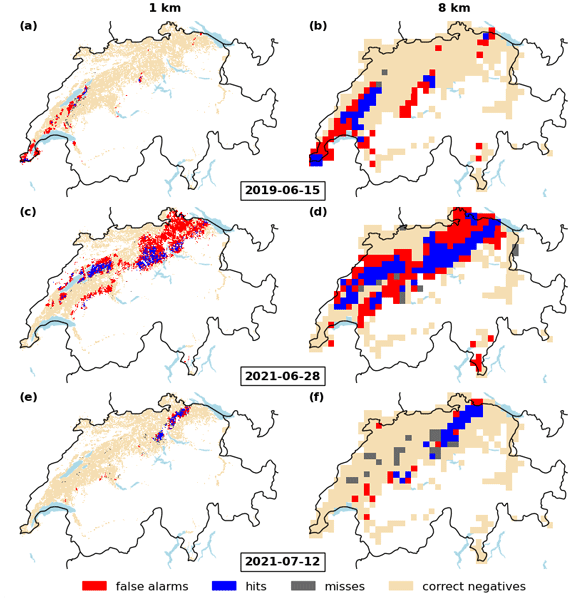
Raphael Portmann, Timo Schmid, Leonie Villiger, David N. Bresch, and Pierluigi Calanca
Nat. Hazards Earth Syst. Sci., 24, 2541–2558, https://doi.org/10.5194/nhess-24-2541-2024, https://doi.org/10.5194/nhess-24-2541-2024, 2024
Short summary
Short summary
The study presents an open-source model to determine the occurrence of hail damage to field crops and grapevines after hailstorms in Switzerland based on radar, agricultural land use data, and insurance damage reports. The model performs best at 8 km resolution for field crops and 1 km for grapevine and in the main production areas. Highlighting performance trade-offs and the relevance of user needs, the study is a first step towards the assessment of risk and damage for crops in Switzerland.
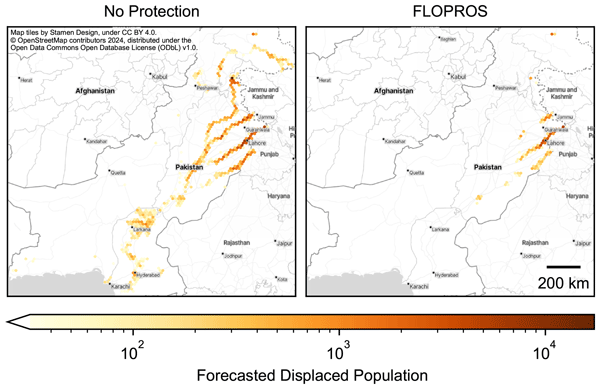
Lukas Riedel, Thomas Röösli, Thomas Vogt, and David N. Bresch
Geosci. Model Dev., 17, 5291–5308, https://doi.org/10.5194/gmd-17-5291-2024, https://doi.org/10.5194/gmd-17-5291-2024, 2024
Short summary
Short summary
River floods are among the most devastating natural hazards. We propose a flood model with a statistical approach based on openly available data. The model is integrated in a framework for estimating impacts of physical hazards. Although the model only agrees moderately with satellite-detected flood extents, we show that it can be used for forecasting the magnitude of flood events in terms of socio-economic impacts and for comparing these with past events.
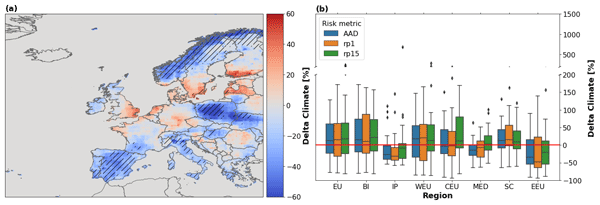
Luca G. Severino, Chahan M. Kropf, Hilla Afargan-Gerstman, Christopher Fairless, Andries Jan de Vries, Daniela I. V. Domeisen, and David N. Bresch
Nat. Hazards Earth Syst. Sci., 24, 1555–1578, https://doi.org/10.5194/nhess-24-1555-2024, https://doi.org/10.5194/nhess-24-1555-2024, 2024
Short summary
Short summary
We combine climate projections from 30 climate models with a climate risk model to project winter windstorm damages in Europe under climate change. We study the uncertainty and sensitivity factors related to the modelling of hazard, exposure and vulnerability. We emphasize high uncertainties in the damage projections, with climate models primarily driving the uncertainty. We find climate change reshapes future European windstorm risk by altering damage locations and intensity.
Bjorn Stevens, Stefan Adami, Tariq Ali, Hartwig Anzt, Zafer Aslan, Sabine Attinger, Jaana Bäck, Johanna Baehr, Peter Bauer, Natacha Bernier, Bob Bishop, Hendryk Bockelmann, Sandrine Bony, Guy Brasseur, David N. Bresch, Sean Breyer, Gilbert Brunet, Pier Luigi Buttigieg, Junji Cao, Christelle Castet, Yafang Cheng, Ayantika Dey Choudhury, Deborah Coen, Susanne Crewell, Atish Dabholkar, Qing Dai, Francisco Doblas-Reyes, Dale Durran, Ayoub El Gaidi, Charlie Ewen, Eleftheria Exarchou, Veronika Eyring, Florencia Falkinhoff, David Farrell, Piers M. Forster, Ariane Frassoni, Claudia Frauen, Oliver Fuhrer, Shahzad Gani, Edwin Gerber, Debra Goldfarb, Jens Grieger, Nicolas Gruber, Wilco Hazeleger, Rolf Herken, Chris Hewitt, Torsten Hoefler, Huang-Hsiung Hsu, Daniela Jacob, Alexandra Jahn, Christian Jakob, Thomas Jung, Christopher Kadow, In-Sik Kang, Sarah Kang, Karthik Kashinath, Katharina Kleinen-von Königslöw, Daniel Klocke, Uta Kloenne, Milan Klöwer, Chihiro Kodama, Stefan Kollet, Tobias Kölling, Jenni Kontkanen, Steve Kopp, Michal Koran, Markku Kulmala, Hanna Lappalainen, Fakhria Latifi, Bryan Lawrence, June Yi Lee, Quentin Lejeun, Christian Lessig, Chao Li, Thomas Lippert, Jürg Luterbacher, Pekka Manninen, Jochem Marotzke, Satoshi Matsouoka, Charlotte Merchant, Peter Messmer, Gero Michel, Kristel Michielsen, Tomoki Miyakawa, Jens Müller, Ramsha Munir, Sandeep Narayanasetti, Ousmane Ndiaye, Carlos Nobre, Achim Oberg, Riko Oki, Tuba Özkan-Haller, Tim Palmer, Stan Posey, Andreas Prein, Odessa Primus, Mike Pritchard, Julie Pullen, Dian Putrasahan, Johannes Quaas, Krishnan Raghavan, Venkatachalam Ramaswamy, Markus Rapp, Florian Rauser, Markus Reichstein, Aromar Revi, Sonakshi Saluja, Masaki Satoh, Vera Schemann, Sebastian Schemm, Christina Schnadt Poberaj, Thomas Schulthess, Cath Senior, Jagadish Shukla, Manmeet Singh, Julia Slingo, Adam Sobel, Silvina Solman, Jenna Spitzer, Philip Stier, Thomas Stocker, Sarah Strock, Hang Su, Petteri Taalas, John Taylor, Susann Tegtmeier, Georg Teutsch, Adrian Tompkins, Uwe Ulbrich, Pier-Luigi Vidale, Chien-Ming Wu, Hao Xu, Najibullah Zaki, Laure Zanna, Tianjun Zhou, and Florian Ziemen
Earth Syst. Sci. Data, 16, 2113–2122, https://doi.org/10.5194/essd-16-2113-2024, https://doi.org/10.5194/essd-16-2113-2024, 2024
Short summary
Short summary
To manage Earth in the Anthropocene, new tools, new institutions, and new forms of international cooperation will be required. Earth Virtualization Engines is proposed as an international federation of centers of excellence to empower all people to respond to the immense and urgent challenges posed by climate change.
Timo Schmid, Raphael Portmann, Leonie Villiger, Katharina Schröer, and David N. Bresch
Nat. Hazards Earth Syst. Sci., 24, 847–872, https://doi.org/10.5194/nhess-24-847-2024, https://doi.org/10.5194/nhess-24-847-2024, 2024
Short summary
Short summary
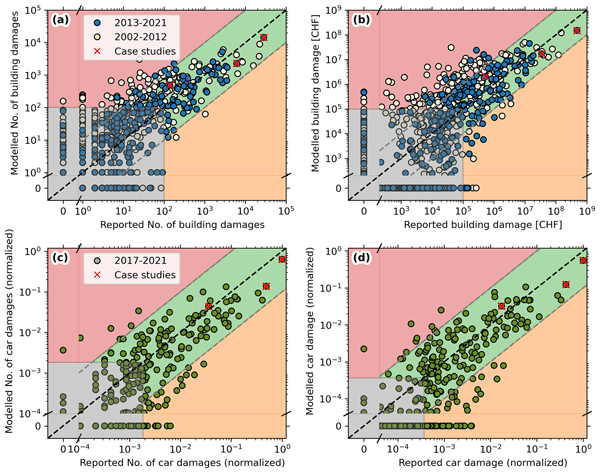
Hailstorms cause severe damage to buildings and cars, which motivates a detailed risk assessment. Here, we present a new open-source hail damage model based on radar data in Switzerland. The model successfully estimates the correct order of magnitude of car and building damages for most large hail events over 20 years. However, large uncertainty remains in the geographical distribution of modelled damages, which can be improved for individual events by using crowdsourced hail reports.
Christophe Lienert, Franziska Angly Bieri, Wolfgang Ruf, Mathias Gross, and Mathias Zesiger
Abstr. Int. Cartogr. Assoc., 6, 140, https://doi.org/10.5194/ica-abs-6-140-2023, https://doi.org/10.5194/ica-abs-6-140-2023, 2023
Gregor Ortner, Michael Bründl, Chahan M. Kropf, Thomas Röösli, Yves Bühler, and David N. Bresch
Nat. Hazards Earth Syst. Sci., 23, 2089–2110, https://doi.org/10.5194/nhess-23-2089-2023, https://doi.org/10.5194/nhess-23-2089-2023, 2023
Short summary
Short summary
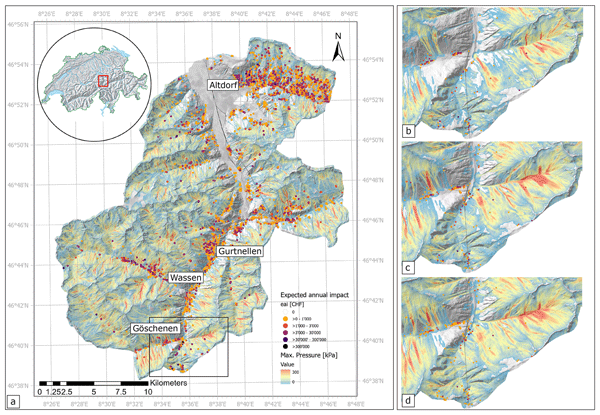
This paper presents a new approach to assess avalanche risk on a large scale in mountainous regions. It combines a large-scale avalanche modeling method with a state-of-the-art probabilistic risk tool. Over 40 000 individual avalanches were simulated, and a building dataset with over 13 000 single buildings was investigated. With this new method, risk hotspots can be identified and surveyed. This enables current and future risk analysis to assist decision makers in risk reduction and adaptation.
Chahan M. Kropf, Alessio Ciullo, Laura Otth, Simona Meiler, Arun Rana, Emanuel Schmid, Jamie W. McCaughey, and David N. Bresch
Geosci. Model Dev., 15, 7177–7201, https://doi.org/10.5194/gmd-15-7177-2022, https://doi.org/10.5194/gmd-15-7177-2022, 2022
Short summary
Short summary
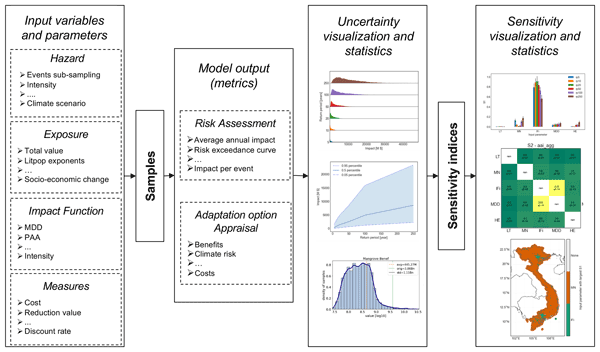
Mathematical models are approximations, and modellers need to understand and ideally quantify the arising uncertainties. Here, we describe and showcase the first, simple-to-use, uncertainty and sensitivity analysis module of the open-source and open-access climate-risk modelling platform CLIMADA. This may help to enhance transparency and intercomparison of studies among climate-risk modellers, help focus future research, and lead to better-informed decisions on climate adaptation.
Christophe Lienert, Franziska Angly Bieri, Irina Dallo, and Michèle Marti
Abstr. Int. Cartogr. Assoc., 5, 154, https://doi.org/10.5194/ica-abs-5-154-2022, https://doi.org/10.5194/ica-abs-5-154-2022, 2022
Zélie Stalhandske, Valentina Nesa, Marius Zumwald, Martina S. Ragettli, Alina Galimshina, Niels Holthausen, Martin Röösli, and David N. Bresch
Nat. Hazards Earth Syst. Sci., 22, 2531–2541, https://doi.org/10.5194/nhess-22-2531-2022, https://doi.org/10.5194/nhess-22-2531-2022, 2022
Short summary
Short summary
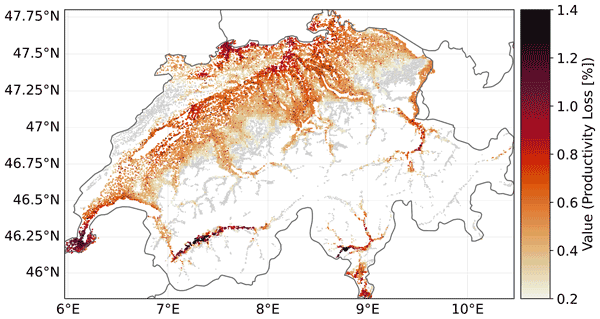
We model the impacts of heat on both mortality and labour productivity in Switzerland in a changing climate. We estimate 658 heat-related death currently per year in Switzerland and CHF 665 million in losses in labour productivity. Should we remain on a high-emissions pathway, these values may double or even triple by the end of the century. Under a lower-emissions scenario impacts are expected to slightly increase and peak by around mid-century.
Christophe Lienert, Franziska Angly, Barbora Neveršil, and Daniel Meier
Abstr. Int. Cartogr. Assoc., 3, 180, https://doi.org/10.5194/ica-abs-3-180-2021, https://doi.org/10.5194/ica-abs-3-180-2021, 2021
Horst Kremers
Abstr. Int. Cartogr. Assoc., 3, 163, https://doi.org/10.5194/ica-abs-3-163-2021, https://doi.org/10.5194/ica-abs-3-163-2021, 2021
Samuel Lüthi, Gabriela Aznar-Siguan, Christopher Fairless, and David N. Bresch
Geosci. Model Dev., 14, 7175–7187, https://doi.org/10.5194/gmd-14-7175-2021, https://doi.org/10.5194/gmd-14-7175-2021, 2021
Short summary
Short summary
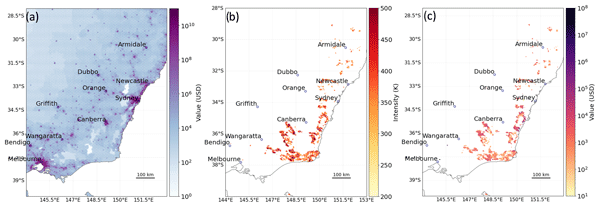
In light of the dramatic increase in economic impacts due to wildfires, the need for modelling impacts of wildfire damage is ever increasing. Insurance companies, households, humanitarian organisations and governmental authorities are worried by climate risks. In this study we present an approach to modelling wildfire impacts using the open-source modelling platform CLIMADA. All input data are free, public and globally available, ensuring applicability in data-scarce regions of the Global South.


