From Information to Action: Standardizing and Harmonizing Warnings in Germany's Natural Hazards Portal for Effective Public Communication
Bodo Erhardt
Deutscher Wetterdienst, Offenbach, Germany
Christoph Brendel
Deutscher Wetterdienst, Offenbach, Germany
Mario Hafer
Deutscher Wetterdienst, Offenbach, Germany
Michael Haller
Deutscher Wetterdienst, Offenbach, Germany
Christian Koziar
Deutscher Wetterdienst, Offenbach, Germany
Katharina Lengfeld
Deutscher Wetterdienst, Offenbach, Germany
Dinah Kristin Leschzyk
Deutscher Wetterdienst, Offenbach, Germany
Armin Rauthe-Schöch
Deutscher Wetterdienst, Offenbach, Germany
Hella Riede
Deutscher Wetterdienst, Offenbach, Germany
Ewelina Walawender
Deutscher Wetterdienst, Offenbach, Germany
Related authors
No articles found.
Tabea Wilke, Katharina Lengfeld, and Markus Schultze
Nat. Hazards Earth Syst. Sci., 25, 3141–3159, https://doi.org/10.5194/nhess-25-3141-2025, https://doi.org/10.5194/nhess-25-3141-2025, 2025
Short summary
Short summary
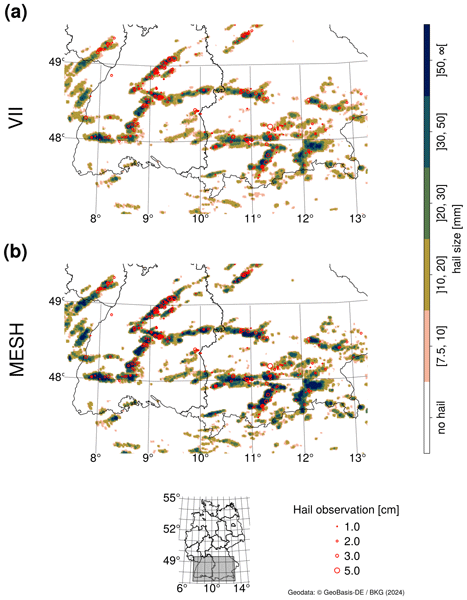
Hail represents a natural hazard in Germany and has potentially substantial economic and environmental impacts, but it often receives less attention than other weather phenomena. In this study we focus on hail frequency, sizes and spatial distribution in Germany based on crowdsourcing and weather radar data. We compare different algorithms based on weather radar data with crowdsourced data and show the annual and diurnal cycle of hail in Germany.
Magdalena Uber, Michael Haller, Christoph Brendel, Gudrun Hillebrand, and Thomas Hoffmann
Hydrol. Earth Syst. Sci., 28, 87–102, https://doi.org/10.5194/hess-28-87-2024, https://doi.org/10.5194/hess-28-87-2024, 2024
Short summary
Short summary
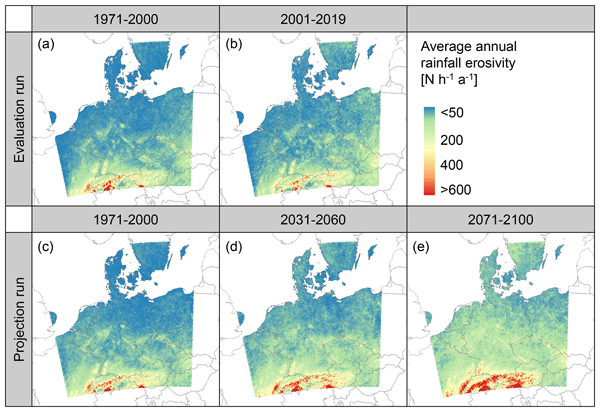
We calculated past, present and future rainfall erosivity in central Europe from high-resolution precipitation data (3 km and 1 h) generated by the COSMO-CLM convection-permitting climate model. Future rainfall erosivity can be up to 84 % higher than it was in the past. Such increases are much higher than estimated previously from regional climate model output. Convection-permitting simulations have an enormous and, to date, unexploited potential for the calculation of future rainfall erosivity.
Katharina Lengfeld, Paul Voit, Frank Kaspar, and Maik Heistermann
Nat. Hazards Earth Syst. Sci., 23, 1227–1232, https://doi.org/10.5194/nhess-23-1227-2023, https://doi.org/10.5194/nhess-23-1227-2023, 2023
Short summary
Short summary
Estimating the severity of a rainfall event based on the damage caused is easy but highly depends on the affected region. A less biased measure for the extremeness of an event is its rarity combined with its spatial extent. In this brief communication, we investigate the sensitivity of such measures to the underlying dataset and highlight the importance of considering multiple spatial and temporal scales using the devastating rainfall event in July 2021 in central Europe as an example.
Vera Thiemig, Goncalo N. Gomes, Jon O. Skøien, Markus Ziese, Armin Rauthe-Schöch, Elke Rustemeier, Kira Rehfeldt, Jakub P. Walawender, Christine Kolbe, Damien Pichon, Christoph Schweim, and Peter Salamon
Earth Syst. Sci. Data, 14, 3249–3272, https://doi.org/10.5194/essd-14-3249-2022, https://doi.org/10.5194/essd-14-3249-2022, 2022
Short summary
Short summary
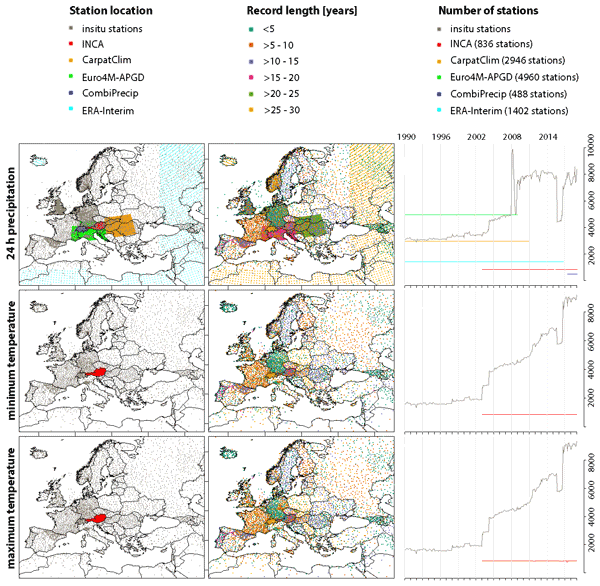
EMO-5 is a free and open European high-resolution (5 km), sub-daily, multi-variable (precipitation, temperatures, wind speed, solar radiation, vapour pressure), multi-decadal meteorological dataset based on quality-controlled observations coming from almost 30 000 stations across Europe, and is produced in near real-time. EMO-5 (v1) covers the time period from 1990 to 2019. In this paper, we have provided insight into the source data, the applied methods, and the quality assessment of EMO-5.