
14 Mar 2025
| 14 Mar 2025
Automatization and innovation in the production of severe weather warnings – insights from MeteoSwiss
Irina Mahlstein
Federal Office of Meteorology and Climatology MeteoSwiss, Switzerland
Evelyn Mühlhofer
Federal Office of Meteorology and Climatology MeteoSwiss, Switzerland
Lea Beusch
Federal Office of Meteorology and Climatology MeteoSwiss, Switzerland
Saskia Willemse
Federal Office of Meteorology and Climatology MeteoSwiss, Switzerland
Related authors
Gabriela Espejo, Firdewsa Zukanovik, Evelyn Mühlhofer, and Irina Mahlstein
Abstr. Int. Cartogr. Assoc., 9, 38, https://doi.org/10.5194/ica-abs-9-38-2025, https://doi.org/10.5194/ica-abs-9-38-2025, 2025
Luca Gaetan Severino, Evelyn Mühlhofer, Nishadh Kalladath, and David Niklaus Bresch
EGUsphere, https://doi.org/10.5194/egusphere-2026-5363, https://doi.org/10.5194/egusphere-2026-5363, 2026
This preprint is open for discussion and under review for Natural Hazards and Earth System Sciences (NHESS).
Short summary
Short summary
Impact forecasts can help reduce negative consequences from weather and climate extremes. We present a framework that predicts flood-induced disruptions to healthcare accessibility for population and apply it to two recent flood events in Africa. Our model is able to provide actionable and timely information such as forecast maps of service accessibility. Our results illustrate how a model built on open-source data can provide decision-relevant impact forecasts to inform anticipatory action.
Gabriela Espejo, Firdewsa Zukanovik, Evelyn Mühlhofer, and Irina Mahlstein
Abstr. Int. Cartogr. Assoc., 9, 38, https://doi.org/10.5194/ica-abs-9-38-2025, https://doi.org/10.5194/ica-abs-9-38-2025, 2025
Nathalie Appenzeller, Saskia Willemse, Markus Aebischer, and Marcel Belz
Abstr. Int. Cartogr. Assoc., 9, 2, https://doi.org/10.5194/ica-abs-9-2-2025, https://doi.org/10.5194/ica-abs-9-2-2025, 2025
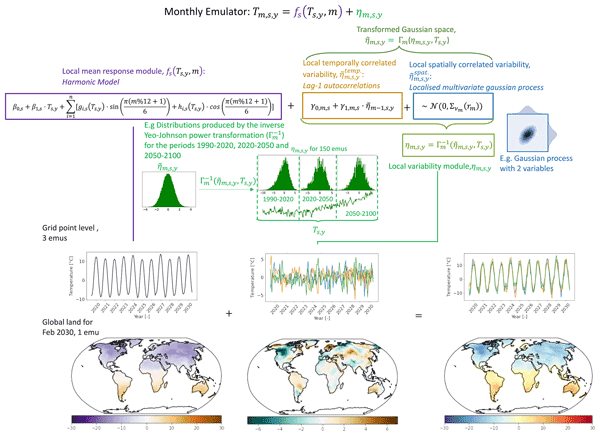
Shruti Nath, Quentin Lejeune, Lea Beusch, Sonia I. Seneviratne, and Carl-Friedrich Schleussner
Earth Syst. Dynam., 13, 851–877, https://doi.org/10.5194/esd-13-851-2022, https://doi.org/10.5194/esd-13-851-2022, 2022
Short summary
Short summary
Uncertainty within climate model projections on inter-annual timescales is largely affected by natural climate variability. Emulators are valuable tools for approximating climate model runs, allowing for easy exploration of such uncertainty spaces. This study takes a first step at building a spatially resolved, monthly temperature emulator that takes local yearly temperatures as the sole input, thus providing monthly temperature distributions which are of critical value to impact assessments.
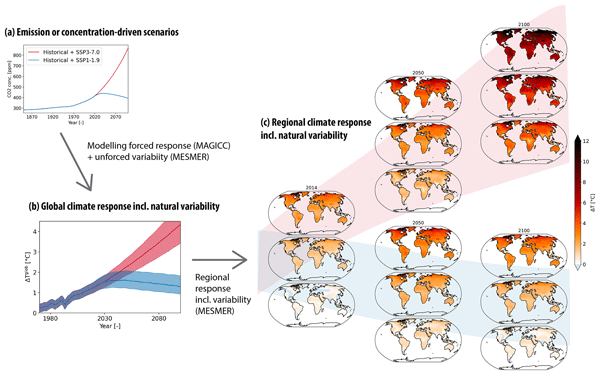
Lea Beusch, Zebedee Nicholls, Lukas Gudmundsson, Mathias Hauser, Malte Meinshausen, and Sonia I. Seneviratne
Geosci. Model Dev., 15, 2085–2103, https://doi.org/10.5194/gmd-15-2085-2022, https://doi.org/10.5194/gmd-15-2085-2022, 2022
Short summary
Short summary
We introduce the first chain of computationally efficient Earth system model (ESM) emulators to translate user-defined greenhouse gas emission pathways into regional temperature change time series accounting for all major sources of climate change projection uncertainty. By combining the global mean emulator MAGICC with the spatially resolved emulator MESMER, we can derive ESM-specific and constrained probabilistic emulations to rapidly provide targeted climate information at the local scale.


