The (story-) line between numerical simulations for hazard assessment, visual communication, and risk perception
Alessandro Cicoira
GEOTEST AG, Switzerland
Daniel Tobler
GEOTEST AG, Switzerland
Rachel Riner
GEOTEST AG, Switzerland
Lars Blatny
WSL Institute for Snow and Avalanche Research SLF, Davos, Switzerland
Climate Change, Extremes, and Natural Hazards in Alpine Regions Research Center CERC, Davos, Switzerland
Institute for Geotechnical Engineering, ETH Zürich, Switzerland
Michael Lukas Kyburz
WSL Institute for Snow and Avalanche Research SLF, Davos, Switzerland
Climate Change, Extremes, and Natural Hazards in Alpine Regions Research Center CERC, Davos, Switzerland
Institute for Geotechnical Engineering, ETH Zürich, Switzerland
Johan Gaume
WSL Institute for Snow and Avalanche Research SLF, Davos, Switzerland
Climate Change, Extremes, and Natural Hazards in Alpine Regions Research Center CERC, Davos, Switzerland
Institute for Geotechnical Engineering, ETH Zürich, Switzerland
Related authors
No articles found.
Lars Blatny and Johan Gaume
Geosci. Model Dev., 18, 9149–9166, https://doi.org/10.5194/gmd-18-9149-2025, https://doi.org/10.5194/gmd-18-9149-2025, 2025
Short summary
Short summary
Matter is a new computer model that simulates granular media like sand, snow, and soil. These materials can behave like both solids and fluids, making their modeling difficult. Matter addresses this with a unified framework, using a numerical solver called MPM. Able to capture cohesion, density variations and complex terrains, it's particularly relevant for snow avalanches or landslides. Matter runs efficiently on standard computers, making advanced simulations more accessible.
Hervé Vicari, Michael Lukas Kyburz, and Johan Gaume
Nat. Hazards Earth Syst. Sci., 25, 3897–3904, https://doi.org/10.5194/nhess-25-3897-2025, https://doi.org/10.5194/nhess-25-3897-2025, 2025
Short summary
Short summary
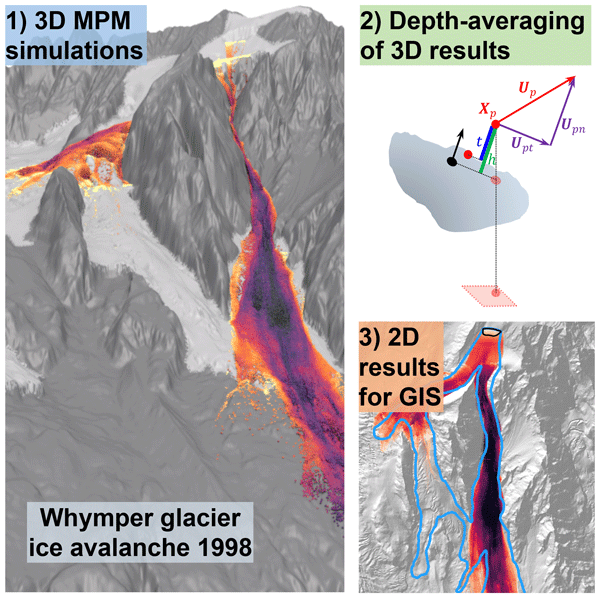
Advanced 3D numerical models can simulate alpine mass movements at the slope scale, but their use in natural hazard mapping remains challenging. We present a tool that converts 3D simulation results into 2D maps, making them more accessible and useful for hazard assessment and mitigation. Applied to an ice avalanche simulated with the Material Point Method, it reveals key features such as slope-normal velocities and flow detachment from terrain, which are often overlooked in simpler models.
Julia Glaus, Katreen Wikstrom Jones, Perry Bartelt, Marc Christen, Lukas Stoffel, Johan Gaume, and Yves Bühler
Nat. Hazards Earth Syst. Sci., 25, 2399–2419, https://doi.org/10.5194/nhess-25-2399-2025, https://doi.org/10.5194/nhess-25-2399-2025, 2025
Short summary
Short summary
This study assesses RAMMS::EXTENDED's predictive power in estimating avalanche runout distances critical for mountain road safety. Leveraging meteorological data and sensitivity analyses, it offers meaningful predictions, aiding near real-time hazard assessments and future model refinement for improved decision-making.
Grégoire Bobillier, Bertil Trottet, Bastian Bergfeld, Ron Simenhois, Alec van Herwijnen, Jürg Schweizer, and Johan Gaume
Nat. Hazards Earth Syst. Sci., 25, 2215–2223, https://doi.org/10.5194/nhess-25-2215-2025, https://doi.org/10.5194/nhess-25-2215-2025, 2025
Short summary
Short summary
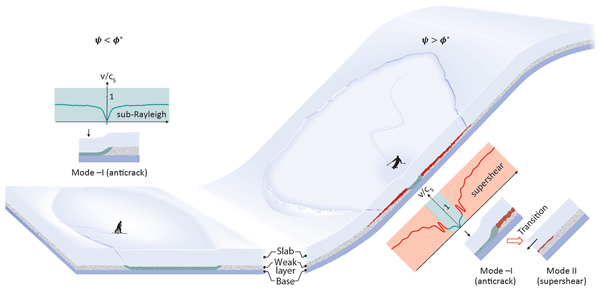
Our study investigates the initiation of snow slab avalanches. Combining experimental data with numerical simulations, we show that on gentle slopes, cracks form and propagate due to compressive fractures within a weak layer. On steeper slopes, crack velocity can increase dramatically after approximately 5 m due to a fracture mode transition from compression to shear. Understanding these dynamics provides a crucial missing piece in the puzzle of dry-snow slab avalanche formation.
Andrea Manconi, Yves Bühler, Andreas Stoffel, Johan Gaume, Qiaoping Zhang, and Valentyn Tolpekin
Nat. Hazards Earth Syst. Sci., 24, 3833–3839, https://doi.org/10.5194/nhess-24-3833-2024, https://doi.org/10.5194/nhess-24-3833-2024, 2024
Short summary
Short summary
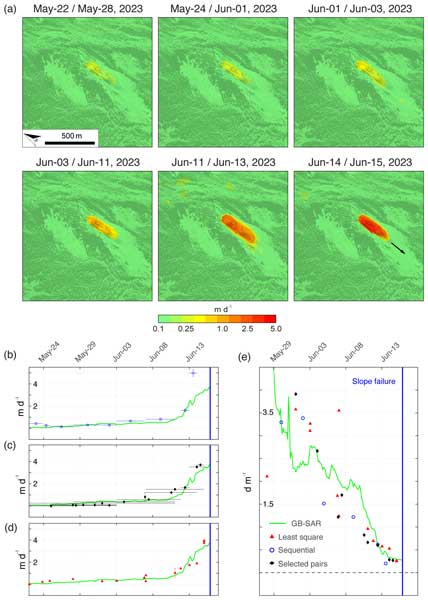
Our research reveals the power of high-resolution satellite synthetic-aperture radar (SAR) imagery for slope deformation monitoring. Using ICEYE data over the Brienz/Brinzauls instability, we measured surface velocity and mapped the landslide event with unprecedented precision. This underscores the potential of satellite SAR for timely hazard assessment in remote regions and aiding disaster mitigation efforts effectively.
Louis Védrine, Xingyue Li, and Johan Gaume
Nat. Hazards Earth Syst. Sci., 22, 1015–1028, https://doi.org/10.5194/nhess-22-1015-2022, https://doi.org/10.5194/nhess-22-1015-2022, 2022
Short summary
Short summary
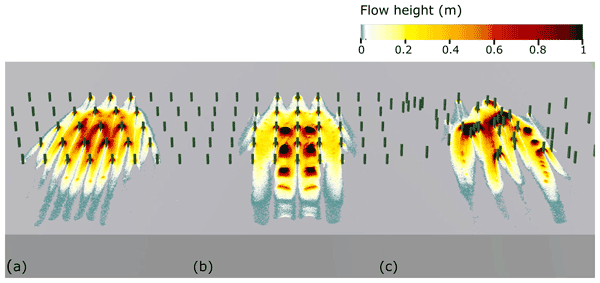
This study investigates how forests affect the behaviour of snow avalanches through the evaluation of the amount of snow stopped by the trees and the analysis of energy dissipation mechanisms. Different avalanche features and tree configurations have been examined, leading to the proposal of a unified law for the detrained snow mass. Outcomes from this study can be directly implemented in operational models for avalanche risk assessment and contribute to improved forest management strategy.