
14 Mar 2025
| 14 Mar 2025
Towards an Operational Groundwater Level Forecasting System in Switzerland
Raoul Alexandre Collenteur
Eawag, Eawag, Dept. Water Resources and Drinking Water (W+T), Dübendorf, Switzerland
Konrad Bogner
Swiss Federal Research Insitute WSL, Birmensdorf, Switzerland
Christian Moeck
Eawag, Eawag, Dept. Water Resources and Drinking Water (W+T), Dübendorf, Switzerland
Massimiliano Zappa
Swiss Federal Research Insitute WSL, Birmensdorf, Switzerland
Mario Schirmer
Eawag, Eawag, Dept. Water Resources and Drinking Water (W+T), Dübendorf, Switzerland
Related authors
Raoul A. Collenteur, Konrad Bogner, Massimiliano Zappa, Mario Schirmer, and Christian Moeck
EGUsphere, https://doi.org/10.5194/egusphere-2025-4653, https://doi.org/10.5194/egusphere-2025-4653, 2025
Short summary
Short summary
Groundwater is vital for drinking water and farming, but recent droughts revealed it is less reliable than once believed. We developed and tested a new system in Switzerland that combines detailed weather forecasts with a groundwater model to anticipate changes weeks in advance. The system often predicted levels up to a month ahead well, though mountain regions proved harder to forecast. These results highlight both the promise and limits of such tools for improving future water planning.
Raoul A. Collenteur, Ezra Haaf, Mark Bakker, Tanja Liesch, Andreas Wunsch, Jenny Soonthornrangsan, Jeremy White, Nick Martin, Rui Hugman, Ed de Sousa, Didier Vanden Berghe, Xinyang Fan, Tim J. Peterson, Jānis Bikše, Antoine Di Ciacca, Xinyue Wang, Yang Zheng, Maximilian Nölscher, Julian Koch, Raphael Schneider, Nikolas Benavides Höglund, Sivarama Krishna Reddy Chidepudi, Abel Henriot, Nicolas Massei, Abderrahim Jardani, Max Gustav Rudolph, Amir Rouhani, J. Jaime Gómez-Hernández, Seifeddine Jomaa, Anna Pölz, Tim Franken, Morteza Behbooei, Jimmy Lin, and Rojin Meysami
Hydrol. Earth Syst. Sci., 28, 5193–5208, https://doi.org/10.5194/hess-28-5193-2024, https://doi.org/10.5194/hess-28-5193-2024, 2024
Short summary
Short summary
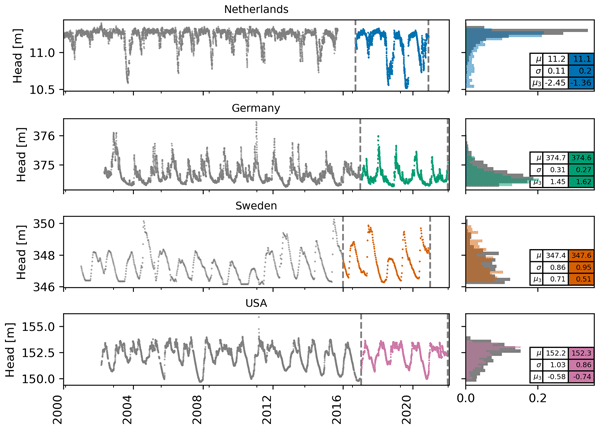
We show the results of the 2022 Groundwater Time Series Modelling Challenge; 15 teams applied data-driven models to simulate hydraulic heads, and three model groups were identified: lumped, machine learning, and deep learning. For all wells, reasonable performance was obtained by at least one team from each group. There was not one team that performed best for all wells. In conclusion, the challenge was a successful initiative to compare different models and learn from each other.
Matevž Vremec, Raoul A. Collenteur, and Steffen Birk
Geosci. Model Dev., 17, 7083–7103, https://doi.org/10.5194/gmd-17-7083-2024, https://doi.org/10.5194/gmd-17-7083-2024, 2024
Short summary
Short summary
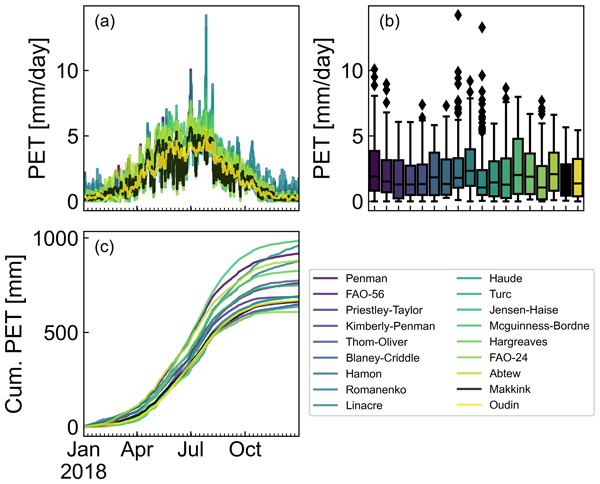
Geoscientists commonly use various potential evapotranpiration (PET) formulas for environmental studies, which can be prone to errors and sensitive to climate change. PyEt, a tested and open-source Python package, simplifies the application of 20 PET methods for both time series and gridded data, ensuring accurate and consistent PET estimations suitable for a wide range of environmental applications.
Matevž Vremec, Raoul A. Collenteur, and Steffen Birk
Hydrol. Earth Syst. Sci. Discuss., https://doi.org/10.5194/hess-2022-417, https://doi.org/10.5194/hess-2022-417, 2023
Manuscript not accepted for further review
Short summary
Short summary
This paper introduced PyEt, a Python package for the estimation of daily potential evapotranspiration (PET). The package enables the inclusion of model uncertainty and climate change into the estimation of PET in a consistent, tested, and reproducible environment. With PyEt, users can estimate PET using 20 different methods for both 1D and 3D data, allowing a more sophisticated and comprehensive consideration of PET in hydrological studies, particularly those related to climate change.
Fabien Courvoisier, Basil Kraft, Yann Yasser Haddad, Massimiliano Zappa, and Lukas Gudmundsson
Hydrol. Earth Syst. Sci., 30, 5873–5900, https://doi.org/10.5194/hess-30-5873-2026, https://doi.org/10.5194/hess-30-5873-2026, 2026
Short summary
Short summary
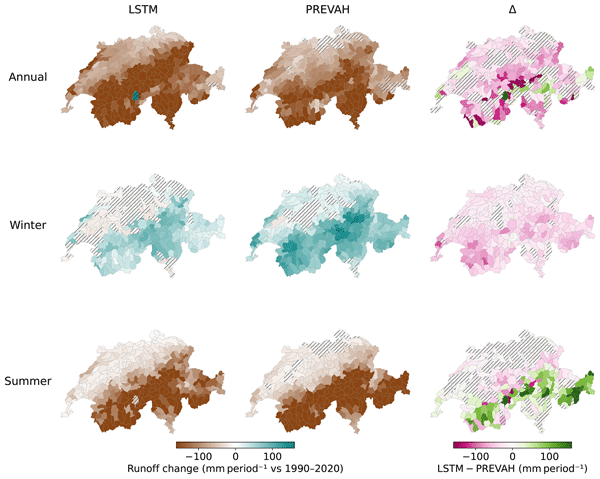
Climate change strongly modifies runoff in alpine regions like Switzerland, altering water supply and affecting both human sectors and natural ecosystems. We test whether a model that learns only from past observations can credibly project future runoff under climate scenarios. It captures major expected shifts and reveals known limits for extremes. Its speed and ability to generalize across catchments make it a promising tool for assessing climate impacts on water resources.
Marit van Tiel, Matthias Huss, Massimiliano Zappa, Tobias Jonas, and Daniel Farinotti
Hydrol. Earth Syst. Sci., 30, 23–43, https://doi.org/10.5194/hess-30-23-2026, https://doi.org/10.5194/hess-30-23-2026, 2026
Short summary
Short summary
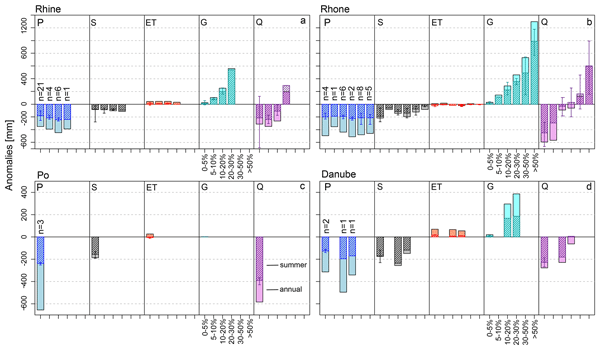
The summer of 2022 was extremely warm and dry in Europe, severely impacting water availability. We calculated water balance anomalies for 88 glacierized catchments in Switzerland, showing that glaciers played a crucial role in alleviating the drought situation by melting at record rates, partially compensating for the lack of rain and snowmelt. By comparing 2022 with past extreme years, we show that while glacier meltwater remains essential during droughts, its contribution is declining.
Raoul A. Collenteur, Konrad Bogner, Massimiliano Zappa, Mario Schirmer, and Christian Moeck
EGUsphere, https://doi.org/10.5194/egusphere-2025-4653, https://doi.org/10.5194/egusphere-2025-4653, 2025
Short summary
Short summary
Groundwater is vital for drinking water and farming, but recent droughts revealed it is less reliable than once believed. We developed and tested a new system in Switzerland that combines detailed weather forecasts with a groundwater model to anticipate changes weeks in advance. The system often predicted levels up to a month ahead well, though mountain regions proved harder to forecast. These results highlight both the promise and limits of such tools for improving future water planning.
Annie Y.-Y. Chang, Shaun Harrigan, Maria-Helena Ramos, Massimiliano Zappa, Christian M. Grams, Daniela I. V. Domeisen, and Konrad Bogner
EGUsphere, https://doi.org/10.5194/egusphere-2025-3411, https://doi.org/10.5194/egusphere-2025-3411, 2025
Short summary
Short summary
This study presents a machine learning-aided hybrid forecasting framework to improve early warnings of low flows in the European Alps. It combines weather regime information, streamflow observations, and model simulations (EFAS). Even using only weather regime data improves predictions over climatology, while integrating different data sources yields the best result, emphasizing the value of integrating diverse data sources.
Ryan S. Padrón, Massimiliano Zappa, Luzi Bernhard, and Konrad Bogner
Hydrol. Earth Syst. Sci., 29, 1685–1702, https://doi.org/10.5194/hess-29-1685-2025, https://doi.org/10.5194/hess-29-1685-2025, 2025
Short summary
Short summary
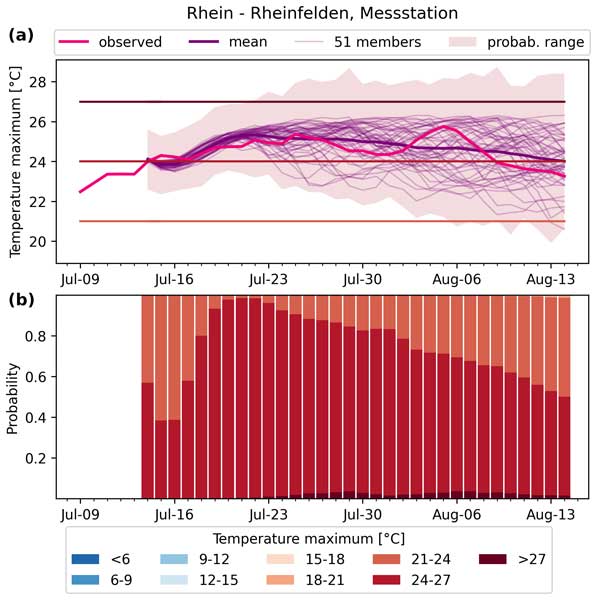
We generate operational forecasts of daily maximum stream water temperature for 32 consecutive days at 54 stations in Switzerland with our best-performing data-driven model. The average forecast error is 0.38 °C for 1 d ahead and increases to 0.90 °C for 32 d ahead given the uncertainty in the meteorological variables influencing water temperature. Here we compare the skill of several models, how well they can forecast at new and ungauged stations, and the importance of different model inputs.
Basil Kraft, Michael Schirmer, William H. Aeberhard, Massimiliano Zappa, Sonia I. Seneviratne, and Lukas Gudmundsson
Hydrol. Earth Syst. Sci., 29, 1061–1082, https://doi.org/10.5194/hess-29-1061-2025, https://doi.org/10.5194/hess-29-1061-2025, 2025
Short summary
Short summary
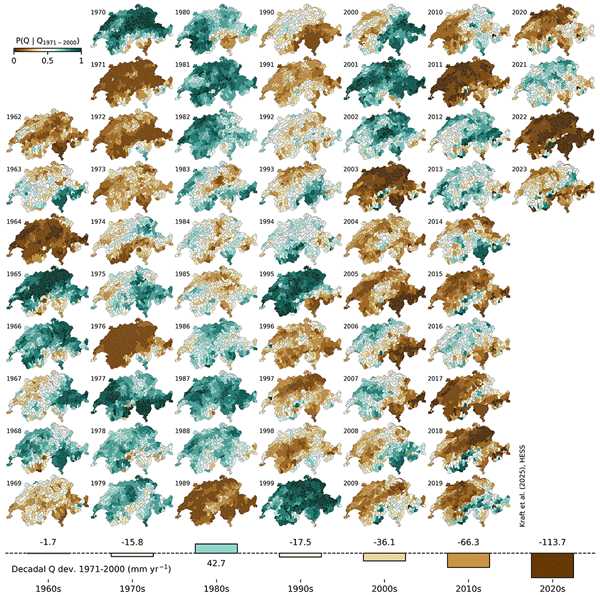
This study reconstructs daily runoff in Switzerland (1962–2023) using a deep-learning model, providing a spatially contiguous dataset on a medium-sized catchment grid. The model outperforms traditional hydrological methods, revealing shifts in Swiss water resources, including more frequent dry years and declining summer runoff. The reconstruction is publicly available.
Raoul A. Collenteur, Ezra Haaf, Mark Bakker, Tanja Liesch, Andreas Wunsch, Jenny Soonthornrangsan, Jeremy White, Nick Martin, Rui Hugman, Ed de Sousa, Didier Vanden Berghe, Xinyang Fan, Tim J. Peterson, Jānis Bikše, Antoine Di Ciacca, Xinyue Wang, Yang Zheng, Maximilian Nölscher, Julian Koch, Raphael Schneider, Nikolas Benavides Höglund, Sivarama Krishna Reddy Chidepudi, Abel Henriot, Nicolas Massei, Abderrahim Jardani, Max Gustav Rudolph, Amir Rouhani, J. Jaime Gómez-Hernández, Seifeddine Jomaa, Anna Pölz, Tim Franken, Morteza Behbooei, Jimmy Lin, and Rojin Meysami
Hydrol. Earth Syst. Sci., 28, 5193–5208, https://doi.org/10.5194/hess-28-5193-2024, https://doi.org/10.5194/hess-28-5193-2024, 2024
Short summary
Short summary
We show the results of the 2022 Groundwater Time Series Modelling Challenge; 15 teams applied data-driven models to simulate hydraulic heads, and three model groups were identified: lumped, machine learning, and deep learning. For all wells, reasonable performance was obtained by at least one team from each group. There was not one team that performed best for all wells. In conclusion, the challenge was a successful initiative to compare different models and learn from each other.
Matevž Vremec, Raoul A. Collenteur, and Steffen Birk
Geosci. Model Dev., 17, 7083–7103, https://doi.org/10.5194/gmd-17-7083-2024, https://doi.org/10.5194/gmd-17-7083-2024, 2024
Short summary
Short summary
Geoscientists commonly use various potential evapotranpiration (PET) formulas for environmental studies, which can be prone to errors and sensitive to climate change. PyEt, a tested and open-source Python package, simplifies the application of 20 PET methods for both time series and gridded data, ensuring accurate and consistent PET estimations suitable for a wide range of environmental applications.
Michael Margreth, Florian Lustenberger, Dorothea Hug Peter, Fritz Schlunegger, and Massimiliano Zappa
Nat. Hazards Earth Syst. Sci. Discuss., https://doi.org/10.5194/nhess-2024-78, https://doi.org/10.5194/nhess-2024-78, 2024
Publication in NHESS not foreseen
Short summary
Short summary
Recession models (RM) are crucial for observing the low flow behavior of a catchment. We developed two novel RM, which are designed to represent slowly draining catchment conditions. With a newly designed low flow prediction procedure we tested the prediction capability of these two models and three others from literature. One of our novel products delivered the best results, because it best represents the slowly draining catchment conditions.
Marvin Höge, Martina Kauzlaric, Rosi Siber, Ursula Schönenberger, Pascal Horton, Jan Schwanbeck, Marius Günter Floriancic, Daniel Viviroli, Sibylle Wilhelm, Anna E. Sikorska-Senoner, Nans Addor, Manuela Brunner, Sandra Pool, Massimiliano Zappa, and Fabrizio Fenicia
Earth Syst. Sci. Data, 15, 5755–5784, https://doi.org/10.5194/essd-15-5755-2023, https://doi.org/10.5194/essd-15-5755-2023, 2023
Short summary
Short summary
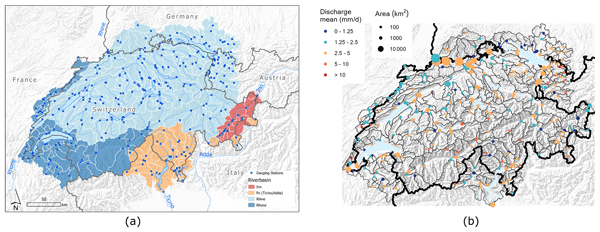
CAMELS-CH is an open large-sample hydro-meteorological data set that covers 331 catchments in hydrologic Switzerland from 1 January 1981 to 31 December 2020. It comprises (a) daily data of river discharge and water level as well as meteorologic variables like precipitation and temperature; (b) yearly glacier and land cover data; (c) static attributes of, e.g, topography or human impact; and (d) catchment delineations. CAMELS-CH enables water and climate research and modeling at catchment level.
Louise J. Slater, Louise Arnal, Marie-Amélie Boucher, Annie Y.-Y. Chang, Simon Moulds, Conor Murphy, Grey Nearing, Guy Shalev, Chaopeng Shen, Linda Speight, Gabriele Villarini, Robert L. Wilby, Andrew Wood, and Massimiliano Zappa
Hydrol. Earth Syst. Sci., 27, 1865–1889, https://doi.org/10.5194/hess-27-1865-2023, https://doi.org/10.5194/hess-27-1865-2023, 2023
Short summary
Short summary
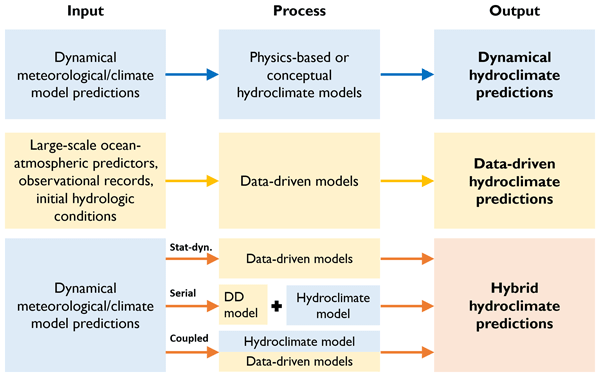
Hybrid forecasting systems combine data-driven methods with physics-based weather and climate models to improve the accuracy of predictions for meteorological and hydroclimatic events such as rainfall, temperature, streamflow, floods, droughts, tropical cyclones, or atmospheric rivers. We review recent developments in hybrid forecasting and outline key challenges and opportunities in the field.
Matevž Vremec, Raoul A. Collenteur, and Steffen Birk
Hydrol. Earth Syst. Sci. Discuss., https://doi.org/10.5194/hess-2022-417, https://doi.org/10.5194/hess-2022-417, 2023
Manuscript not accepted for further review
Short summary
Short summary
This paper introduced PyEt, a Python package for the estimation of daily potential evapotranspiration (PET). The package enables the inclusion of model uncertainty and climate change into the estimation of PET in a consistent, tested, and reproducible environment. With PyEt, users can estimate PET using 20 different methods for both 1D and 3D data, allowing a more sophisticated and comprehensive consideration of PET in hydrological studies, particularly those related to climate change.


