User-centred Evaluation of Cold Wave Forecasts for Disaster Risk Reduction in Lesotho
Katherine Egan
ECMWF, Reading, UK
Calum Baugh
ECMWF, Reading, UK
Rebecca Emerton
ECMWF, Reading, UK
Christel Prudhomme
ECMWF, Reading, UK
Daniele Castellana
510 The Netherlands Red Cross, The Netherlands
Sebongile Hlubi
The Lesotho Red Cross Society, Lesotho
Related authors
No articles found.
Gwyneth Matthews, Hannah L. Cloke, Sarah L. Dance, and Christel Prudhomme
Hydrol. Earth Syst. Sci., 29, 6157–6179, https://doi.org/10.5194/hess-29-6157-2025, https://doi.org/10.5194/hess-29-6157-2025, 2025
Short summary
Short summary
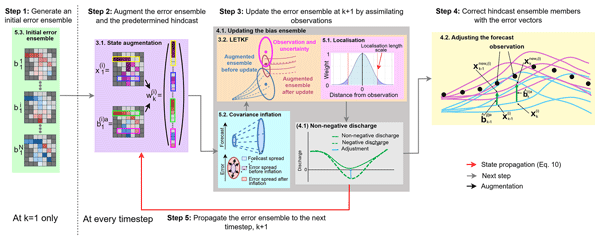
Forecasts provide information crucial for managing floods and for water resource planning, but they often have errors. “Post-processing” reduces these errors but is usually only applied at river gauges, leaving areas without gauges uncorrected. We developed a new method that uses spatial information contained within the forecast to spread information about the errors from gauged locations to ungauged areas. Our results show that the method successfully makes river forecasts more accurate.
Hamidreza Mosaffa, Florian Pappenberger, Christel Prudhomme, Matthew Chantry, Christoph Rüdiger, and Hannah Cloke
EGUsphere, https://doi.org/10.5194/egusphere-2025-5008, https://doi.org/10.5194/egusphere-2025-5008, 2025
This preprint is open for discussion and under review for Hydrology and Earth System Sciences (HESS).
Short summary
Short summary
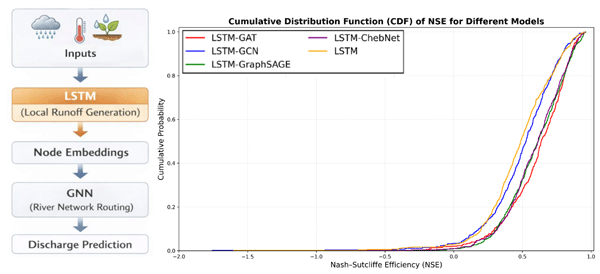
This study improves river flow prediction by combining two types of artificial intelligence models to better represent how rainfall turns into runoff and moves through river systems. Tested on the Upper Danube River Basin, the new model more accurately predicts streamflow, especially in large and connected rivers. These findings can help enhance flood forecasting and water management.
Jeffrey Neal, Anthony Cooper, Stephen Chuter, Leanne Archer, Laura Devitt, Stephen Grey, Laurence Hawker, James Savage, Elisabeth Stephens, Calum Baugh, Tim Sumner, Katherine Marsden, and Tamara Janes
EGUsphere, https://doi.org/10.5194/egusphere-2025-3473, https://doi.org/10.5194/egusphere-2025-3473, 2025
This preprint is open for discussion and under review for Natural Hazards and Earth System Sciences (NHESS).
Short summary
Short summary
East Africa has recently experienced a series of devastating tropical cyclone landfalls characterised by hundreds of fatalities, millions of displaced people and substantial economic damage. This paper describes an approach to forecasting the number of people directly exposed to flooding from tropical cyclones and documents experience gained communicating these forecasts to practitioners via emergency bulletins.
Margarita Choulga, Francesca Moschini, Cinzia Mazzetti, Stefania Grimaldi, Juliana Disperati, Hylke Beck, Peter Salamon, and Christel Prudhomme
Hydrol. Earth Syst. Sci., 28, 2991–3036, https://doi.org/10.5194/hess-28-2991-2024, https://doi.org/10.5194/hess-28-2991-2024, 2024
Short summary
Short summary
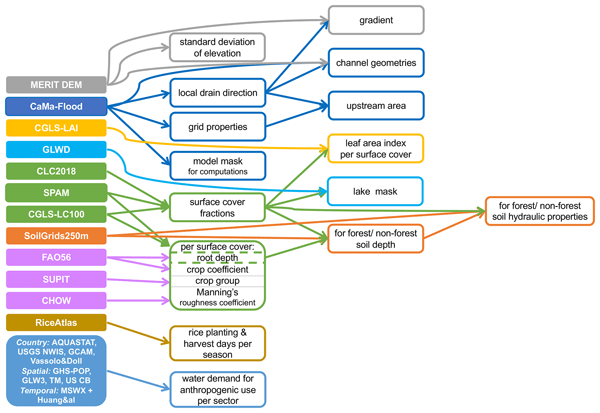
CEMS_SurfaceFields_2022 dataset is a new set of high-resolution maps for land type (e.g. lake, forest), soil properties and population water needs at approximately 2 and 6 km at the Equator, covering Europe and the globe (excluding Antarctica). We describe what and how new high-resolution information can be used to create the dataset. The paper suggests that the dataset can be used as input for river, weather or other models, as well as for statistical descriptions of the region of interest.
Shaun Harrigan, Ervin Zsoter, Hannah Cloke, Peter Salamon, and Christel Prudhomme
Hydrol. Earth Syst. Sci., 27, 1–19, https://doi.org/10.5194/hess-27-1-2023, https://doi.org/10.5194/hess-27-1-2023, 2023
Short summary
Short summary
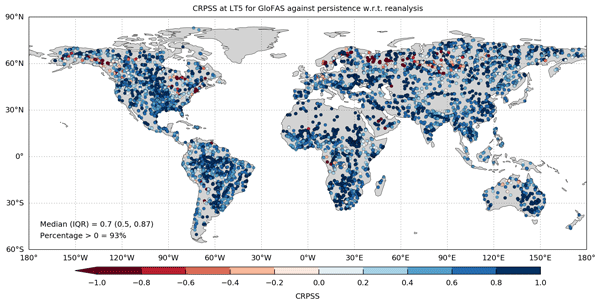
Real-time river discharge forecasts and reforecasts from the Global Flood Awareness System (GloFAS) have been made publicly available, together with an evaluation of forecast skill at the global scale. Results show that GloFAS is skillful in over 93 % of catchments in the short (1–3 d) and medium range (5–15 d) and skillful in over 80 % of catchments in the extended lead time (16–30 d). Skill is summarised in a new layer on the GloFAS Web Map Viewer to aid decision-making.
Kieran M. R. Hunt, Gwyneth R. Matthews, Florian Pappenberger, and Christel Prudhomme
Hydrol. Earth Syst. Sci., 26, 5449–5472, https://doi.org/10.5194/hess-26-5449-2022, https://doi.org/10.5194/hess-26-5449-2022, 2022
Short summary
Short summary
In this study, we use three models to forecast river streamflow operationally for 13 months (September 2020 to October 2021) at 10 gauges in the western US. The first model is a state-of-the-art physics-based streamflow model (GloFAS). The second applies a bias-correction technique to GloFAS. The third is a type of neural network (an LSTM). We find that all three are capable of producing skilful forecasts but that the LSTM performs the best, with skilful 5 d forecasts at nine stations.
Gwyneth Matthews, Christopher Barnard, Hannah Cloke, Sarah L. Dance, Toni Jurlina, Cinzia Mazzetti, and Christel Prudhomme
Hydrol. Earth Syst. Sci., 26, 2939–2968, https://doi.org/10.5194/hess-26-2939-2022, https://doi.org/10.5194/hess-26-2939-2022, 2022
Short summary
Short summary
The European Flood Awareness System creates flood forecasts for up to 15 d in the future for the whole of Europe which are made available to local authorities. These forecasts can be erroneous because the weather forecasts include errors or because the hydrological model used does not represent the flow in the rivers correctly. We found that, by using recent observations and a model trained with past observations and forecasts, the real-time forecast can be corrected, thus becoming more useful.
Seán Donegan, Conor Murphy, Shaun Harrigan, Ciaran Broderick, Dáire Foran Quinn, Saeed Golian, Jeff Knight, Tom Matthews, Christel Prudhomme, Adam A. Scaife, Nicky Stringer, and Robert L. Wilby
Hydrol. Earth Syst. Sci., 25, 4159–4183, https://doi.org/10.5194/hess-25-4159-2021, https://doi.org/10.5194/hess-25-4159-2021, 2021
Short summary
Short summary
We benchmarked the skill of ensemble streamflow prediction (ESP) for a diverse sample of 46 Irish catchments. We found that ESP is skilful in the majority of catchments up to several months ahead. However, the level of skill was strongly dependent on lead time, initialisation month, and individual catchment location and storage properties. We also conditioned ESP with the winter North Atlantic Oscillation and show that improvements in forecast skill, reliability, and discrimination are possible.