
03 Sep 2024
| 03 Sep 2024
Learning Building Floor Numbers from Crowdsourced Streetview Images
Yifan Tian
Data Science in Earth Observation, Technical University of Munich, Munich, Germany
Data Science in Earth Observation, Technical University of Munich, Munich, Germany
Xiao Xiang Zhu
Data Science in Earth Observation, Technical University of Munich, Munich, Germany
Related authors
Y. Sun, A. Kruspe, L. Meng, Y. Tian, E. J. Hoffmann, S. Auer, and X. X. Zhu
Int. Arch. Photogramm. Remote Sens. Spatial Inf. Sci., XLVIII-1-W2-2023, 225–232, https://doi.org/10.5194/isprs-archives-XLVIII-1-W2-2023-225-2023, https://doi.org/10.5194/isprs-archives-XLVIII-1-W2-2023-225-2023, 2023

Nils Lehmann, Cesar Aybar, Ando Shah, Marcello Passaro, Jonathan L. Bamber, and Xiao Xiang Zhu
Earth Syst. Sci. Data, 18, 6815–6840, https://doi.org/10.5194/essd-18-6815-2026, https://doi.org/10.5194/essd-18-6815-2026, 2026
Short summary
Short summary
Different satellites, ocean floats and model reanalysis products record sea surface height, temperature, salt content and winds, but each archive stores its data differently, so combining them is tedious and time consuming. We therefore combine these data sources into a consistent collection, so that data retrieval across sources becomes easier. Ocean studies are consequently easier to reproduce and compare, and hopefully support research and better understanding of ocean and climate processes.
Viola Steidl, Jürgen Kusche, Fupeng Li, and Xiao Xiang Zhu
EGUsphere, https://doi.org/10.5194/egusphere-2026-2312, https://doi.org/10.5194/egusphere-2026-2312, 2026
Short summary
Short summary
Terrestrial water storage is an indicator of water availability, but forecasting its changes is difficult as it depends on processes acting at varying spatial and temporal scales. We introduce a hierarchical machine learning model that represents the Earth at two scales, the grid scale and the hydrological basin scale, to forecast global water storage changes up to six months ahead. We identify where model skill fades and which challenges to address to improve its forecasts.
Yang Mu, Zhitong Xiong, Yi Wang, Muhammad Shahzad, Franz Essl, Holger Kreft, Mark van Kleunen, and Xiao Xiang Zhu
Earth Syst. Sci. Data, 18, 1379–1403, https://doi.org/10.5194/essd-18-1379-2026, https://doi.org/10.5194/essd-18-1379-2026, 2026
Short summary
Short summary
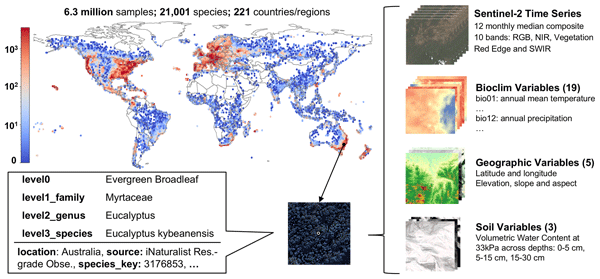
To better protect our planet's forests, we need to know what trees are where. We created GlobalGeoTree, a massive public dataset linking 6.3 million tree locations worldwide with satellite data. This dataset helps computers learn to identify tree species from space, supporting biodiversity monitoring and climate action. Our baseline model shows this is a promising path to understanding global forests.
Xiao Xiang Zhu, Sining Chen, Fahong Zhang, Yilei Shi, and Yuanyuan Wang
Earth Syst. Sci. Data, 17, 6647–6668, https://doi.org/10.5194/essd-17-6647-2025, https://doi.org/10.5194/essd-17-6647-2025, 2025
Short summary
Short summary
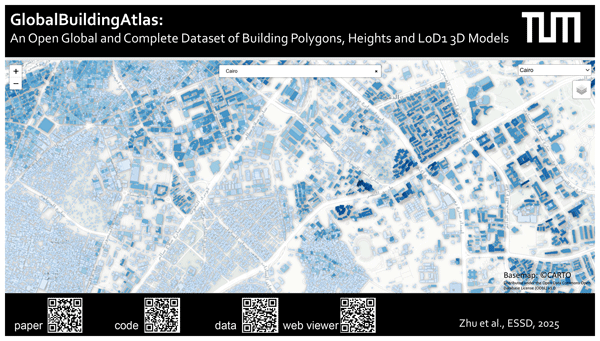
We introduce GlobalBuildingAtlas, a publicly available dataset offering global and complete coverage of building polygons (GBA.Polygon), heights (GBA.Height) and Level of Detail 1 3D models (GBA.LoD1). This is the first open dataset to offer high quality, consistent, and complete building data in 2D and 3D at the individual building level on a global scale. With more than 2.75 billion buildings worldwide, it surpasses the most comprehensive database to date by more than 1 billion buildings.
Zhenghang Yuan, Zhitong Xiong, Lichao Mou, and Xiao Xiang Zhu
Earth Syst. Sci. Data, 17, 1245–1263, https://doi.org/10.5194/essd-17-1245-2025, https://doi.org/10.5194/essd-17-1245-2025, 2025
Short summary
Short summary
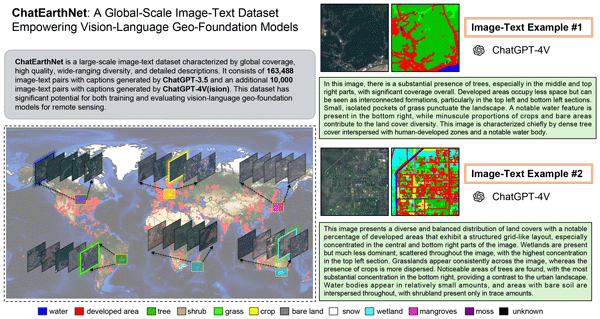
ChatEarthNet is an image–text dataset that provides high-quality, detailed natural language descriptions for global-scale satellite data. It consists of 163 488 image-text pairs with captions generated by ChatGPT-3.5 and an additional 10 000 image-text pairs with captions generated by ChatGPT-4V(ision). This dataset has significant potential for training and evaluating vision–language geo-foundation models in remote sensing.
Viola Steidl, Jonathan Louis Bamber, and Xiao Xiang Zhu
The Cryosphere, 19, 645–661, https://doi.org/10.5194/tc-19-645-2025, https://doi.org/10.5194/tc-19-645-2025, 2025
Short summary
Short summary
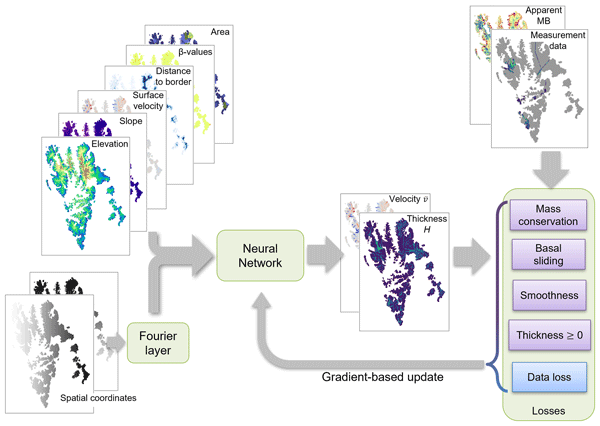
Glacier ice thickness is difficult to measure directly but is essential for glacier evolution modelling. In this work, we employ a novel approach combining physical knowledge and data-driven machine learning to estimate the ice thickness of multiple glaciers in Spitsbergen, Barentsøya, and Edgeøya in Svalbard. We identify challenges for the physics-aware machine learning model and opportunities for improving the accuracy and physical consistency that would also apply to other geophysical tasks.
Erik Loebel, Mirko Scheinert, Martin Horwath, Angelika Humbert, Julia Sohn, Konrad Heidler, Charlotte Liebezeit, and Xiao Xiang Zhu
The Cryosphere, 18, 3315–3332, https://doi.org/10.5194/tc-18-3315-2024, https://doi.org/10.5194/tc-18-3315-2024, 2024
Short summary
Short summary
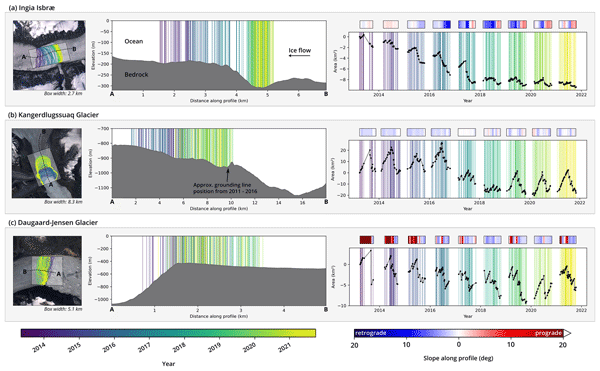
Comprehensive datasets of calving-front changes are essential for studying and modeling outlet glaciers. Current records are limited in temporal resolution due to manual delineation. We use deep learning to automatically delineate calving fronts for 23 glaciers in Greenland. Resulting time series resolve long-term, seasonal, and subseasonal patterns. We discuss the implications of our results and provide the cryosphere community with a data product and an implementation of our processing system.
Weiyan Lin, Jiasong Zhu, Yuansheng Hua, Qingyu Li, Lichao Mou, and Xiao Xiang Zhu
Int. Arch. Photogramm. Remote Sens. Spatial Inf. Sci., XLVIII-1-2024, 371–378, https://doi.org/10.5194/isprs-archives-XLVIII-1-2024-371-2024, https://doi.org/10.5194/isprs-archives-XLVIII-1-2024-371-2024, 2024
Tian Li, Konrad Heidler, Lichao Mou, Ádám Ignéczi, Xiao Xiang Zhu, and Jonathan L. Bamber
Earth Syst. Sci. Data, 16, 919–939, https://doi.org/10.5194/essd-16-919-2024, https://doi.org/10.5194/essd-16-919-2024, 2024
Short summary
Short summary
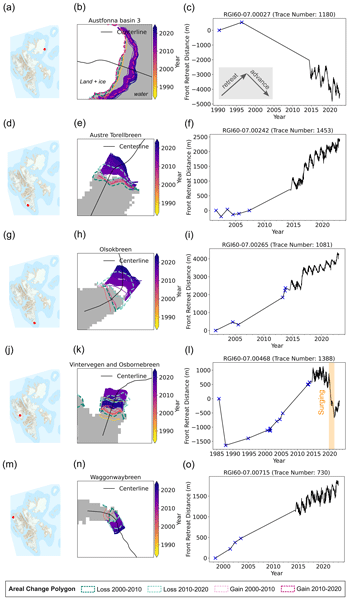
Our study uses deep learning to produce a new high-resolution calving front dataset for 149 marine-terminating glaciers in Svalbard from 1985 to 2023, containing 124 919 terminus traces. This dataset offers insights into understanding calving mechanisms and can help improve glacier frontal ablation estimates as a component of the integrated mass balance assessment.
Y. Sun, A. Kruspe, L. Meng, Y. Tian, E. J. Hoffmann, S. Auer, and X. X. Zhu
Int. Arch. Photogramm. Remote Sens. Spatial Inf. Sci., XLVIII-1-W2-2023, 225–232, https://doi.org/10.5194/isprs-archives-XLVIII-1-W2-2023-225-2023, https://doi.org/10.5194/isprs-archives-XLVIII-1-W2-2023-225-2023, 2023
J. Zhao, F. Roth, B. Bauer-Marschallinger, W. Wagner, M. Chini, and X. X. Zhu
ISPRS Ann. Photogramm. Remote Sens. Spatial Inf. Sci., X-1-W1-2023, 911–918, https://doi.org/10.5194/isprs-annals-X-1-W1-2023-911-2023, https://doi.org/10.5194/isprs-annals-X-1-W1-2023-911-2023, 2023
Yao Sun, Stefan Auer, Liqiu Meng, and Xiao Xiang Zhu
Abstr. Int. Cartogr. Assoc., 6, 250, https://doi.org/10.5194/ica-abs-6-250-2023, https://doi.org/10.5194/ica-abs-6-250-2023, 2023

Jingliang Hu, Rong Liu, Danfeng Hong, Andrés Camero, Jing Yao, Mathias Schneider, Franz Kurz, Karl Segl, and Xiao Xiang Zhu
Earth Syst. Sci. Data, 15, 113–131, https://doi.org/10.5194/essd-15-113-2023, https://doi.org/10.5194/essd-15-113-2023, 2023
Short summary
Short summary
Multimodal data fusion is an intuitive strategy to break the limitation of individual data in Earth observation. Here, we present a multimodal data set, named MDAS, consisting of synthetic aperture radar (SAR), multispectral, hyperspectral, digital surface model (DSM), and geographic information system (GIS) data for the city of Augsburg, Germany, along with baseline models for resolution enhancement, spectral unmixing, and land cover classification, three typical remote sensing applications.
S. Zhao, S. Saha, and X. X. Zhu
Int. Arch. Photogramm. Remote Sens. Spatial Inf. Sci., XLIII-B3-2022, 1407–1413, https://doi.org/10.5194/isprs-archives-XLIII-B3-2022-1407-2022, https://doi.org/10.5194/isprs-archives-XLIII-B3-2022-1407-2022, 2022
S. Saha, J. Gawlikowski, and X. X. Zhu
Int. Arch. Photogramm. Remote Sens. Spatial Inf. Sci., XLIII-B3-2022, 423–428, https://doi.org/10.5194/isprs-archives-XLIII-B3-2022-423-2022, https://doi.org/10.5194/isprs-archives-XLIII-B3-2022-423-2022, 2022
K. R. Traoré, A. Camero, and X. X. Zhu
ISPRS Ann. Photogramm. Remote Sens. Spatial Inf. Sci., V-3-2022, 217–224, https://doi.org/10.5194/isprs-annals-V-3-2022-217-2022, https://doi.org/10.5194/isprs-annals-V-3-2022-217-2022, 2022
T. Beker, H. Ansari, S. Montazeri, Q. Song, and X. X. Zhu
ISPRS Ann. Photogramm. Remote Sens. Spatial Inf. Sci., V-3-2022, 85–92, https://doi.org/10.5194/isprs-annals-V-3-2022-85-2022, https://doi.org/10.5194/isprs-annals-V-3-2022-85-2022, 2022


